Objectives
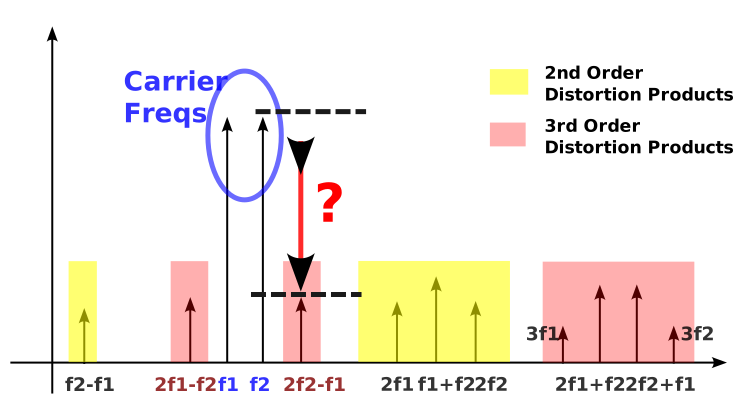
Unfortunately, all active devices inherently exhibit non-linear behavior, which is undesirable yet inevitable. This can be analyzed using Fourier analysis in the spectral domain. Specifically, the third-order intermodulation distortion (IMD3) parameter is a critical metric for evaluating the non-linearity of RF (radio frequency) and microwave systems, such as amplifiers, mixers, and receivers.
Test Methodology
Intermodulation Products in the Frequency Domain
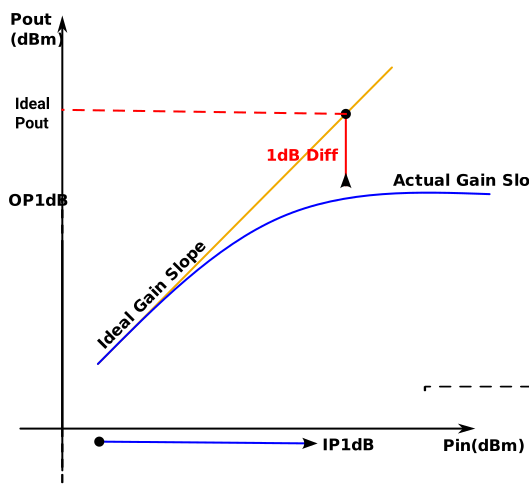
- P1dB: The two common notations for compression points are IP1dB (Input P1dB) and OP1dB (Output P1dB).
IP1dB: The input power level at which an amplifier’s gain compresses by 1 dB compared to its ideal linear gain.
NOTE: The term IP1dBm (Input P1dBm) is not incorrect; it explicitly specifies the unit as dBm, indicating that the power is relative to 1 milliwatt.
Pre-Test Preparation
- Supply all necessary power to the DUT and enable the active mode through digital control.
- Inject a very small input signal within the linear gain region and record the resulting output as the ideal gain (G_ideal)
Test Sequence
- Perform a linear sweep of the input power, starting from a very small signal and increasing up to approximately 3 dB above the IP1dB, using a 0.2 dB step size.
- Plot the gain curve and record the P1dB points. If necessary, reduce the step size to achieve consistent results.
- Report the OP1dB and IP1dB values along with the ideal gain data. The formula for calculating the OP1dB is as follows and is referenced in the figure below:
OP1dB = IP1dB + (Ideal Gain−1) - Measuring the current at the P1dB operating point is also a good practice to ensure the amplifier does not oscillate and is functioning within its specified parameters.