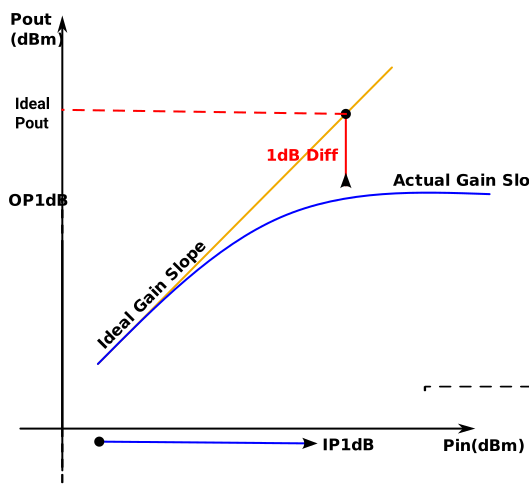
P1dB (1 dB Compression Point) is used to understand the linear performance of an RF or microwave device, such as an amplifier or mixer, in terms of its ability to handle power levels without introducing significant nonlinearity or distortion, which is critical for maintaining signal integrity.
Test Methodology
Terminologies
P1dB: The two common notations for compression points are IP1dB (Input P1dB) and OP1dB (Output P1dB).
IP1dB: The input power level at which an amplifier’s gain compresses by 1 dB compared to its ideal linear gain.
OP1dB: The output power level at which the amplifier’s output deviates by 1 dB from its ideal linear gain response.
NOTE: The term IP1dBm (Input P1dBm) is not incorrect; it explicitly specifies the unit as dBm, indicating that the power is relative to 1 milliwatt.
Pre-Test Preparation
Supply all necessary power to the DUT and enable the active mode through digital control.
Inject a very small input signal within the linear gain region and record the resulting output as the ideal gain (G_ideal)
Test Sequence
Perform a linear sweep of the input power, starting from a very small signal and increasing up to approximately 3 dB above the IP1dB, using a 0.2 dB step size.
Plot the gain curve and record the P1dB points. If necessary, reduce the step size to achieve consistent results.
Report the OP1dB and IP1dB values along with the ideal gain data. The formula for calculating the OP1dB is as follows and is referenced in the figure below: OP1dB = IP1dB + (Ideal Gain−1)
Measuring the current at the P1dB operating point is also a good practice to ensure the amplifier does not oscillate and is functioning within its specified parameters.